
Garage Door Repair: Repair or Replace? How Whitney Homeowners Decide
Age is the least useful number in this decision. A twenty-year-old door with intact panels, a straight torsion tube, and true tracks is a better repair candidate than a twelve-year-old door with two bent sections and a warped bottom panel. What actually decides repair versus replace is three structural checks and one cost ratio. This piece walks Whitney homeowners through both, so the money you spend holds for years instead of months.
If you’d rather have a trained eye on it before you decide, call (844) 797-9248. Estimates are free, and we’ll give you a second opinion on any written quote you already have.
Why age alone tells you almost nothing
We’ve pulled doors out of garages in Whitney that were older than the people living in the house and still had good bones. We’ve also seen doors barely a decade old that were already past saving. Age doesn’t account for sun exposure, how often the door ran, whether the springs were ever balanced, or whether the original install was square. Those four things matter more than the year on the sticker.
Whitney’s climate adds a wrinkle most national advice ignores. The desert sun beats on south- and west-facing doors for most of the day, and the daily swing between afternoon heat and overnight cool works on steel, paint, and seals alike. A door on a shaded north wall can outlast an identical door on a full-sun wall by years. That’s why we ask which way the door faces before we quote anything.
Key Takeaways
- Three visual checks (panels, horizontal tracks, bottom section) tell you more than the door’s age.
- If a repair quote tops 40% of a comparable new door’s installed price, replacement usually wins.
- Panel-only swaps hide costs: paint match, fit to an aging frame, and hardware compatibility.
- A bent torsion tube or cracked drum anchor plate almost always tips the decision toward replacement.
- In Whitney’s heat, insulation values change the math on doors that share a wall with living space.
The three checks you can do before you call anyone
You don’t need tools for any of these. Stand back, look, and listen. Ten minutes of looking saves you from paying for a diagnosis you could have made yourself.
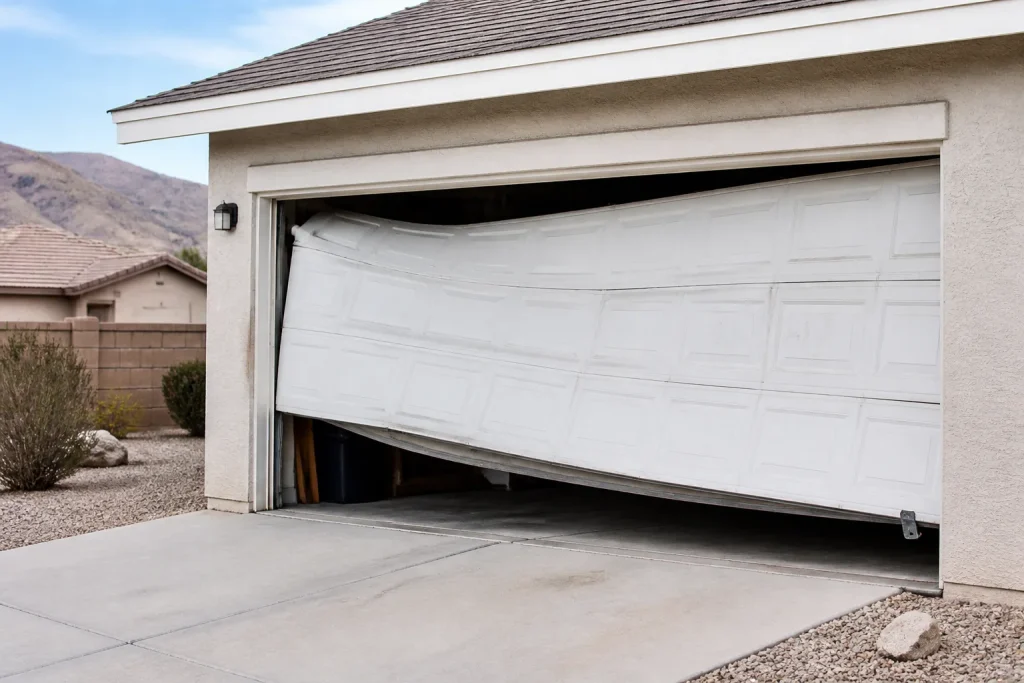
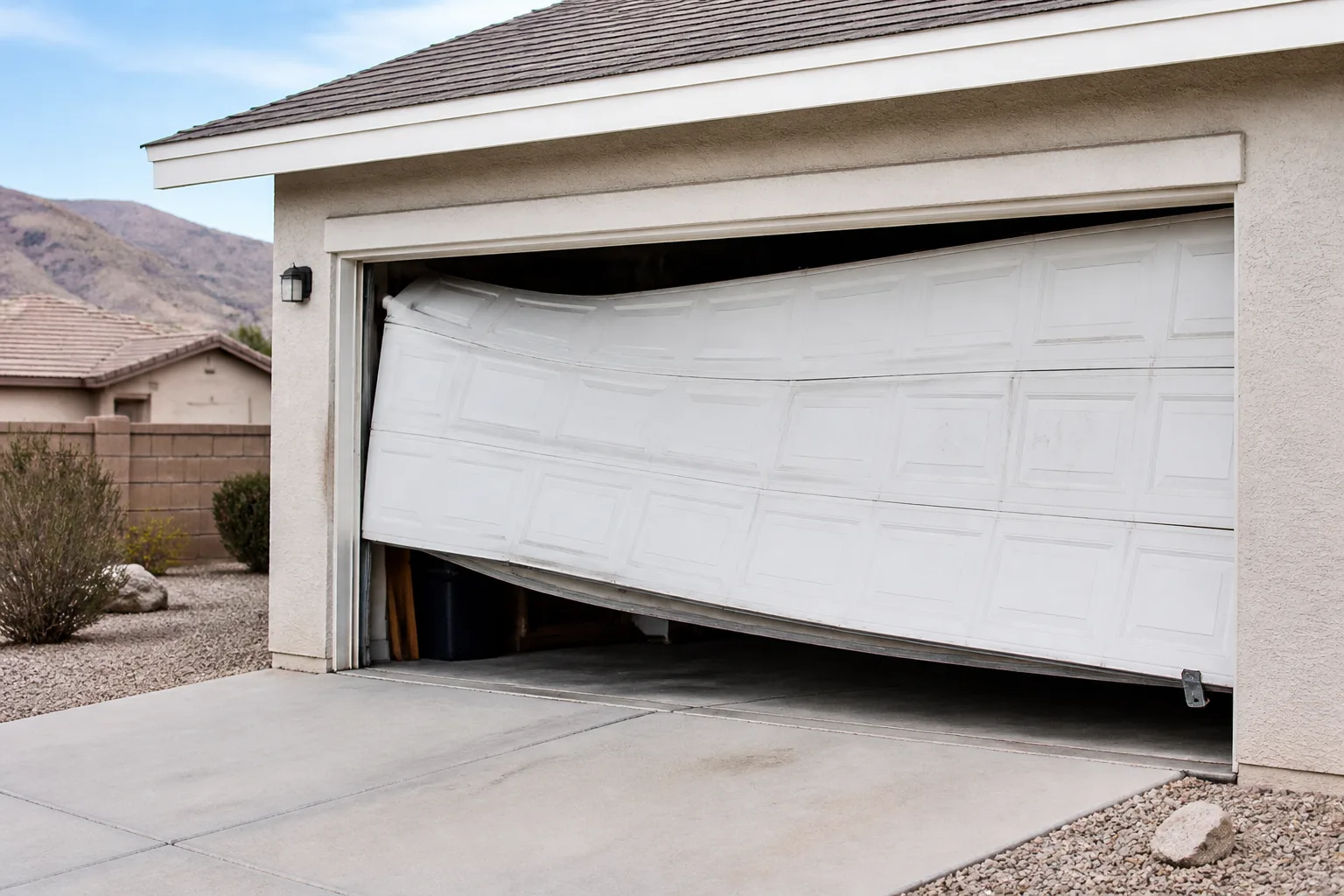
- Panel integrity. Sight down the face of the door from the side. Panels should sit flat against each other with no gaps, no dents that break the seam, and no rust bubbles pushing the paint up. One damaged panel low on the door is often a straightforward fix. Damage that spans two or more panels, or that has twisted the section out of square, is a different conversation.
- Horizontal track alignment. The horizontal tracks should run parallel to each other and level along their length. If one sags or the two aren’t mirror images, the door is dragging, and dragging wears rollers, hinges, and the opener’s gear assembly. Slight misalignment can be corrected. Tracks that are bent, kinked, or pulling away from the jamb usually mean the door took a hit.
- Bottom section straightness. Lay a straightedge, or a level, along the bottom panel. A bottom section that bows, sags in the middle, or has a rotted or crushed bottom seal is a common Whitney finding, because that section takes the weather. A straight bottom section means the door’s foundation is sound.
If all three checks pass, you’re likely looking at a repair. If two or more fail, replacement deserves a serious look.
The 40% rule: when repair stops making financial sense
Here’s the crossover point we use. When a repair estimate climbs past roughly forty percent of what a comparable new door would cost installed, replacement is almost always the better investment. Below that line, repair wins. Above it, you’re putting good money into a structure that will keep asking for more.
Run the numbers honestly. Say a repair quote lands at $950 and a comparable new door installed runs $2,200. That repair is 43% of replacement, which puts it over the line. Now flip it: a $400 spring and roller job against that same $2,200 door is 18%, so repair is the clear call. The ratio does the work, not the age of the door.
Two things shift that math in Whitney. First, labor and material pricing here tracks the broader Nevada market, so a quote that felt reasonable five years ago may not today. Second, the 40% rule assumes the rest of the door has life left in it. A repair on a door with failing panels is money spent on a structure that’s already on its way out, which pulls the crossover point lower.
This is exactly where a free second opinion earns its keep. If you’ve got a written estimate in hand, we’ll look at it at no charge and tell you plainly whether the repair is worth doing. Garage Door Repair in Whitney covers what a typical repair visit involves.
The hidden costs of replacing panels only
Swapping two damaged panels sounds like the budget move. In practice, it often costs more than the sticker suggests, and we’ve watched Whitney homeowners get surprised by all three of these.
- Paint match. A new panel from the factory won’t match a door that’s spent fifteen summers in the Nevada sun. Faded paint, chalked clearcoat, and slight color drift mean the new section reads as a patch. Matching means repainting the whole door, which adds cost and time.
- Fit to an aging frame. Panel profiles change. A replacement panel built for the current generation of a door line may not seat cleanly against hardware and framing from an older one. We’ve had to order panels from discontinued runs, and sometimes the honest answer is that the exact match no longer exists.
- Hardware compatibility. Hinges, rollers, and struts from a newer door line don’t always line up with the mounting points on an older one. That means drilling new holes, which weakens the section, or sourcing older hardware, which adds lead time.
Add those up and a panel swap can close much of the gap to a full replacement. When it does, replacing the whole door is the cleaner spend: new panels, new hardware, matched paint, and a warranty in one shot. Our Garage Door Installation in Whitney page covers what a replacement involves from measure to final adjustment.
The one mechanical failure that flips the decision
Most mechanical problems are repairable. Springs, cables, rollers, and hinges are routine work. One failure sits outside that pattern: a bent torsion tube, or a cracked drum assembly anchor plate.
The torsion tube carries the entire weight of the door through the springs, and it’s anchored to the framing above. When that tube bends, or the plate holding the drum cracks, the door’s whole weight is riding on a compromised structure. Straightening a bent tube rarely holds, and a cracked anchor plate is a structural failure, not a wear item. Once either shows up, patching around it is borrowed time. That’s the point where replacement usually becomes the honest answer, because the door’s load path is no longer sound.
We want to be clear about the safety side here, because this is not a do-it-yourself area. Torsion springs and the cables that run with them store enormous force, and a tube under load can release it suddenly. If you see a bent tube, a cracked plate, or a gap where the drum meets the bracket, keep the door closed and call a trained technician. Don’t try to adjust it yourself. Our technicians have up to 10 years of experience with this exact failure, and we carry the parts to address it.
Insulation and the Whitney heat: the honest energy math
Here’s the angle most repair-or-replace advice skips. In Whitney’s desert climate, an attached garage that shares a wall with conditioned space is a heat problem, not just a parking space. An uninsulated or lightly insulated door lets the afternoon heat soak straight through that shared wall, and your air conditioner pays for it all summer.
The difference between an R-6 door and an R-18 door is measurable. An R-6 door is barely a barrier. An R-18 door slows heat transfer enough to take real load off the rooms on the other side of that wall. For a garage that shares a wall with a bedroom or living room, that can shift the repair-or-replace math on its own, even when the old door is mechanically repairable. If you’re already near the 40% line, the energy savings can tip a marginal repair into a clear replacement.
We’re honest about when this matters and when it doesn’t. A detached garage, or one that shares no wall with living space, gains little from an insulation upgrade, and we’ll tell you so. It’s the attached, shared-wall garage in a Whitney summer that makes the difference worth weighing. The right opener matters too, and a modern unit paired with a well-insulated door runs quieter and lifts less strain over time. See Garage Door Opener in Whitney for how opener choice interacts with door weight.
When to call a pro
Any of these means stop and pick up the phone: a bent torsion tube or cracked drum plate, cables that have jumped their drums or gone slack, a door that’s come off one track, and any door that won’t stay up on its own. Those are the calls where a trained technician matters, and they’re the calls we handle around the clock. Our technicians are background-checked and factory-familiar with LiftMaster and Chamberlain openers, along with Craftsman and Raynor doors, so the right parts are usually already on the truck and most jobs finish in a single visit.
One quick story from the field. We pulled a door out of a garage over in a Whitney neighborhood last month where the homeowner had spent two seasons nursing a single noisy roller. Turned out the drum anchor plate had a hairline crack the whole time. The roller was never the problem. That’s the kind of thing a fifteen-minute look catches before it becomes an emergency.
Related services in Whitney: Mainspring Garage Door Co. Whitney home has the full picture of repair, installation, openers, and emergency response. If you’re weighing a repair against a replacement, the free second opinion offer applies to any written estimate you’ve already received.
The Bottom Line
Ignore the age. Look at the three checks, run the 40% ratio, and watch for a bent torsion tube or a cracked anchor plate. Those four signals decide the question far better than the year the door was built. If the repair quote is comfortably below the 40% line and the structure is sound, repair is the square deal. If it’s over the line, or the load path is compromised, replacement is the better spend, and in a shared-wall garage in Whitney, the insulation upgrade often seals it.
Whatever you decide, you should know the price before any work starts. We state the flat price upfront, finish most jobs in one visit because the parts ride on the truck, and back every job with the 90-Day Done Right Promise in writing. If you’re in Whitney and want a straight answer on repair versus replace, Mainspring Garage Door Co. Whitney offers free estimates. Call (844) 797-9248. A live person answers, day or night. Current offers include $50 off any repair over $250, a free second opinion on any written estimate, an $89 seasonal tune-up, and a permanent 5% discount for seniors and veterans.
Frequently Asked Questions
Check three things: panel integrity, horizontal track alignment, and bottom section straightness. If all three pass, it’s likely a repair. If two or more fail, or a repair quote tops 40% of a comparable new door’s installed price, replacement is usually the better investment. Call (844) 797-9248 for a free estimate and we’ll walk you through it.
Rarely, and we don’t recommend it. A bent torsion tube or a cracked drum anchor plate means the door’s load path is compromised, and straightening a tube under load doesn’t hold. In most cases replacement is the honest answer. This is not a do-it-yourself repair, since torsion springs store dangerous force. Call (844) 797-9248 to have a trained technician assess it.
Sometimes, but often not as much as it looks. Paint match, fit to an aging frame, and hardware compatibility add hidden cost, and those three can close most of the gap to a full replacement. If a panel swap lands near the 40% line, a full replacement is usually the cleaner spend. Call (844) 797-9248 for a free second opinion on any panel-repair quote.
Yes, if the garage shares a wall with living space. In Whitney’s heat, going from an R-6 to an R-18 door measurably reduces heat transfer into conditioned rooms, which can make replacement the better financial call even when the old door is repairable. A detached garage gains little from the upgrade, and we’ll tell you plainly when it’s not worth it. Call (844) 797-9248 to talk through your setup.
Written by the team at Mainspring Garage Door Co. Whitney.
Need Garage Door Help?
Call Mainspring Garage Door Co. Whitney - licensed & insured, here with fast after-hours help in Whitney.
(844) 797-9248