
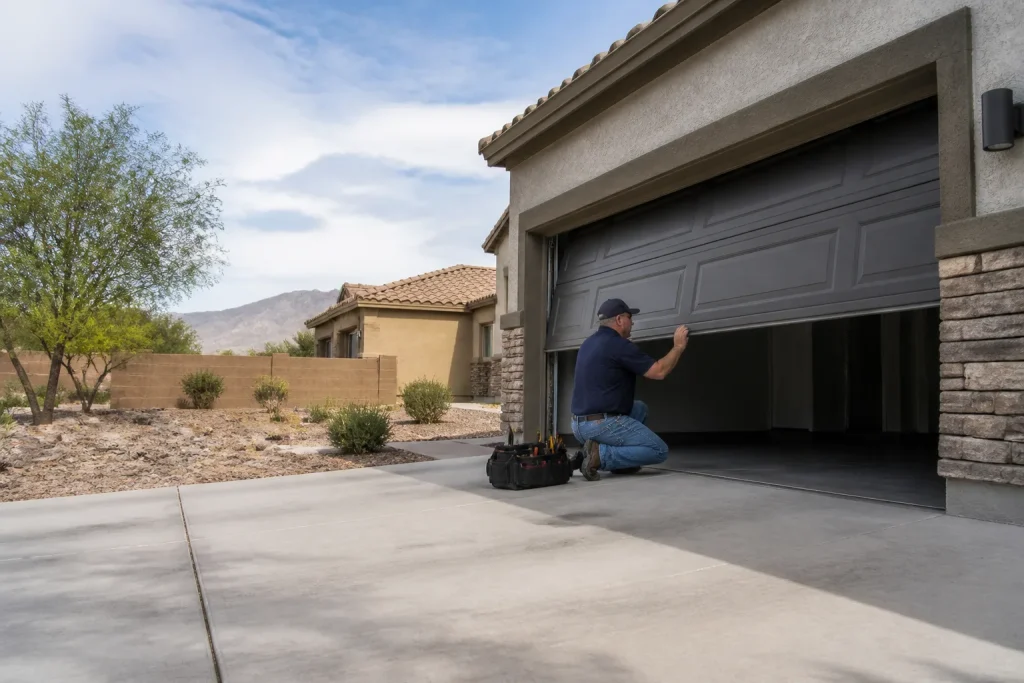
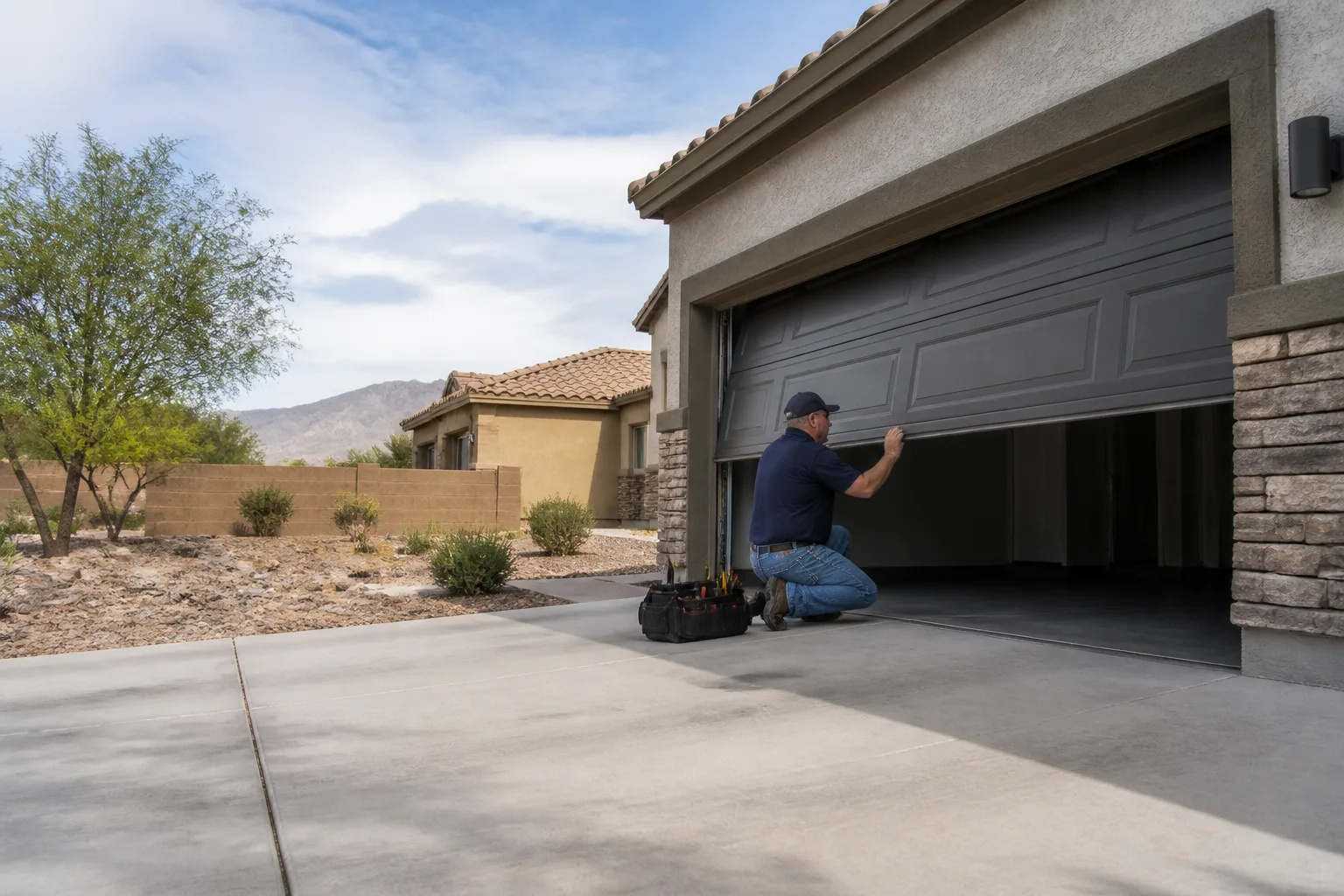
Amarr Garage Door Repair in Whitney: A Homeowner’s Guide
Amarr builds doors to tighter panel tolerances than many competitors, and that precision is exactly why they hold up in wind and desert sun. It’s also why a replacement section pulled from a different Amarr tier can leave a visible gap and a weatherstrip mismatch that no amount of adjustment will close. If you’d rather not chase this on your own, call (844) 797-9248 and we’ll take a look. Getting the right part means matching the door, not just the color.
Key Takeaways
- Color names repeat across Amarr lines. The model number on the label is what actually matters.
- Tight-tolerance joints mean a mismatched section shows daylight immediately, especially in Whitney’s summer sun.
- Hardware differs by line: Heritage, Classica, and Oak Summit do not share interchangeable hinges and rollers.
- Bottom seals wear faster in desert UV and sustained heat above 95°F. That seal is the first thing to fail.
- Some Amarr sections are stocked locally in the Las Vegas area; others require a factory order with real lead time.
Why Amarr Panel Tolerance Matters in Whitney
Amarr cuts panels to tighter joints than a lot of the doors we see, and in Whitney that pays off. The valley gets wind, hard summer sun, and temperature swings from cold desert mornings to triple-digit afternoons. A door with snug panel joints and a good thermal break resists warping, rattling, and water intrusion far better than a loose-fitting section that lets grit and wind work their way in.
The flip side is that the same precision makes repairs less forgiving. When you swap a section from a different Amarr product tier, the joints won’t line up. You get a shadow line, a gap at the seam, and a weatherstrip that sits proud or pulls away, and no hinge adjustment will fix a dimensional mismatch that was there before the hinge went on.
Across the Whitney and Las Vegas Valley, we’ve seen this most on doors that a previous homeowner replaced section by section, buying whatever was close. The gap showed up the first summer. It only got worse. There’s a steady demand across the area for honest Garage Door Repair in Whitney that starts by identifying the door instead of guessing at it.
What to check before you order anything:
- Read the model and series number, not just the color name.
- Note the width and height of the section you need.
- Confirm the insulation type (more on that below).
- Look at the hinge pattern stamped into the section end.
How to Decode Your Amarr Model and Series Number
The label is the whole game. Amarr stamps a model and series number onto the interior of the door, usually on the top or bottom section and sometimes on the back of a panel or the end stile. That number, not the color, tells a supplier exactly which production run built your door. Two doors wearing the same “Almond” label can be different tiers with different steel profiles and different panel geometry.
Here’s how to read it:
- Open the door and look along the inside face of the sections and the end stiles.
- Find the manufacturer label, a sticker or a metal plate with Amarr on it.
- Write down the full model string and the series number exactly as printed. Don’t abbreviate, and don’t round.
- Note the color name as printed too, but treat it as secondary.
- Measure the section width and height, and photograph the label. A clear photo of the label plus one of the hinge line speeds up a quote more than anything else you can do.
If the label is worn or painted over, the hinge pattern and panel profile often identify the line. That takes someone who has handled a lot of Amarr doors. We’ve had to identify doors by hardware and steel profile more than once when the label was long gone.
Heritage, Classica, and Oak Summit: Why the Hardware Isn’t Interchangeable
Amarr’s lines look similar in photos and aren’t built the same underneath. The hinges, rollers, and strut patterns differ by line, and a part that drops into a Heritage door often doesn’t seat correctly in a Classica or an Oak Summit section. This matters most on a section replacement, where the new section has to carry the existing hardware at the same pivot points.
What tends to differ:
- Hinge gauge and pattern. The stamped hinge locations vary by line, so a hinge from one series can bind or sit off-center on another.
- Roller stems. Stem length and diameter differ, and the wrong one rides rough in the track or pops out of the hinge.
- Struts and reinforcement. The wind-load reinforcement patterns are not universal across tiers.
- Panel profile. The raised-panel geometry and joint shape change with the line, which is where the visible gap comes from.
We run into this across Whitney regularly. A homeowner orders a “matching” section from a big-box source, gets it on, and the door runs uneven because the hinge geometry was close but not the same. Close isn’t the same as correct. If you want the door to run quiet and sit flush, the hardware has to match the line the door was built on.
Thermally Broken Sections and Cable Tension Through a Whitney Year
Amarr’s thermally broken sections perform differently in Whitney than standard polystyrene-insulated sections, and it changes how the door carries its weight. A thermally broken door keeps the interior and exterior skins separated by a thermal gap, which cuts heat transfer, resists condensation, and holds its shape through the valley’s cold mornings and hot afternoons. Polystyrene foam filled between skins insulates too, but the skins are joined differently and the section reacts differently to temperature.
That reaction drives cable tension. Steel expands and contracts with temperature, and so do your lift cables and springs. In a Whitney winter, the metal contracts and a slightly loose cable can slip or come off a drum. In summer, expansion can bring slack or a rattle that wasn’t there in January. A thermally broken door, being stiffer and lighter across the span, usually needs less frequent adjustment than a standard insulated section, but it still isn’t immune.
High-tension springs and cables are dangerous. They store enough energy to cause serious injury, and a slipped cable is not a homeowner fix. If you hear a pop, see a gap in the spring, or the door hangs crooked, stop using the door and call a trained technician. This is one of those jobs where the smart move is to not touch it. Our experienced technicians handle spring and cable work on every visit.
Why Amarr Bottom Seals Fail Faster in Desert Heat
The bottom seal is where Whitney homes see the most Amarr wear. The rubber compound Amarr uses in certain product generations degrades faster under sustained UV exposure above 95°F, and the valley serves that heat for months. Our summers bake the seal until it hardens, cracks, and loses its grip on the track. You’ll notice it as a whistle in the wind, a gap of daylight under the door, or dust finding its way in along the bottom.
The signs to watch for:
- The seal is brittle or crumbles when you press it.
- Visible cracks along the bottom edge.
- Daylight or a draft under the closed door.
- Wind noise that wasn’t there a year ago.
- Dirt or sand collecting just inside the door.
The good news is a bottom seal is a straightforward, inexpensive fix, and it’s one of the few Amarr jobs we can usually finish in a single visit because we keep seal stock on hand. In our experience across Whitney, addressing the seal early keeps grit and moisture from working up into the panel seams, where the real damage starts.
When to call a pro: cracked seals, bent tracks, a door that won’t close evenly, or any spring or cable problem. Seals and track adjustments are quick; springs and cables are a job for the technician. Both are covered by our 90-Day Done Right Promise, and the flat price is stated before we touch the door. That way there are no surprises on the bill.
The Amarr Parts Chain in the Whitney and Las Vegas Area
Supply for Amarr in the Whitney and Las Vegas area is a mixed picture, and it’s worth understanding before you order. Common bottom seals, standard hinges, and rollers for the mainstream lines are usually available locally or through a shop that stocks them. Full replacement sections are another story. Popular sizes and the current production runs may be in regional stock, but a specific panel from an older generation or an uncommon size often requires a factory order.
Here’s what a reputable shop should be able to tell you up front:
- Whether the exact section is in regional stock or needs a factory order.
- The realistic lead time for a factory order, in writing.
- Whether the section matches your model string and series number, not just the color name.
- What will be done in the meantime to keep the door safe and weathertight.
What a shop should have on hand versus what needs ordering: seals, hinges, rollers, and hardware are typically stocked; matched panels are often a factory call. We are factory-familiar with Amarr, along with Wayne Dalton and Raynor doors and the openers that drive them, so we can check the model, tell you what your options are, and order correctly the first time rather than risk a return.
Related services in Whitney: if the diagnosis turns into a full replacement rather than a repair, our Garage Door Installation in Whitney service walks you through door options built for the desert. And if the door struggles to lift because the opener is overworked, take a look at Garage Door Opener in Whitney.
The Bottom Line
Amarr doors are worth repairing, and the tight-tolerance build that makes them durable in Whitney’s wind and sun is the same reason the repair has to be matched to your exact model. Read the label, confirm the series number, match the hardware to the line, and order the right section rather than a near one. Handle the bottom seal early, watch cable tension through the seasons, and leave the springs and cables to a trained technician. Across Whitney, most of the failures we see trace back to a mismatched part or a seal left too long.
If you’re in Whitney and need help, Mainspring Garage Door Co. Whitney offers free estimates, calls answered by a live person around the clock, and a flat price stated before work begins. Our technicians have up to 10 years of experience, arrive with parts on the truck so most jobs finish in a single visit, and stand behind the work in writing. Proudly serving local communities for 42 years, founded in 1984, still answering the phone. Take a moment to see our Mainspring Garage Door Co. Whitney home if you want to know more about how we work.
Call (844) 797-9248 for a free estimate and a square deal. We stand behind it, and we will be there when we say.
Frequently Asked Questions
Most Amarr repairs in Whitney fall somewhere between a small hardware swap and a section replacement, and the price depends on whether the part is in regional stock or a factory order. We give you the flat price before any work starts, so there are no surprises on the bill. Call (844) 797-9248 for an exact quote. Estimates are free.
Yes, if we have your model and series number and the section is available. Color names are shared across lines, so the model string is what we use to match the production run. A mismatched tier shows a gap and a seal failure right away. Call (844) 797-9248 and we’ll decode the label with you and confirm the match.
For most repairs, yes. Our phones are answered by a live person 24/7, and if parts are on the truck we often finish in a single visit. If it’s a spring or cable issue, keep the door shut and call so we can make it safe. Call (844) 797-9248 and we’ll tell you what’s realistic today.
No. The flat price is quoted and agreed before work begins. If we find something additional that needs doing, we tell you first and you decide. The 90-Day Done Right Promise is in writing, so if the work isn’t right, we come back at no charge. Call (844) 797-9248 for a free estimate.
Written by the team at Mainspring Garage Door Co. Whitney.
Need Garage Door Help?
Call Mainspring Garage Door Co. Whitney - licensed & insured, here with fast after-hours help in Whitney.
(844) 797-9248